We drank elephant poo coffee. A crap-uccino as some have called it jokingly. Yes, you read that right. And we think it’s a great cup of coffee! Officially it’s called Black Ivory and it’s the rarest and the world’s most expensive coffee.
 So what makes it the world’s most expensive coffee? Black Ivory coffee is produced from the finest Thai Arabica beans that have been handpicked from an altitude of 1500 meters (around 5000 feet). The Arabica beans are then fed to Thai elephants and plucked by mahouts (elephant caretaker) a day later from their dung. The elephants are highly inefficient though. It takes 33 kilograms (72 pounds) of raw coffee cherries to produce 1 kilogram (2 pounds) of Black Ivory coffee. The majority of beans get chewed up, broken or lost in tall grass after being deposited by the elephants.
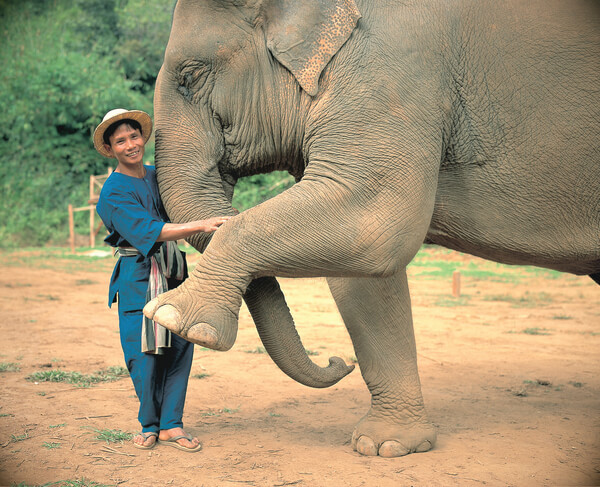
Photo Credit: Anantara
Refinement of the coffee takes place at Anantara’s own foundation the Golden Triangle Asian Elephant Foundation (GTAEF) in Thailand. The foundation has rescued 30 street elephants to date and 8% of all coffee sales were donated to GTAEF to help fund an elephant veterinarian to provide free care to the elephants.
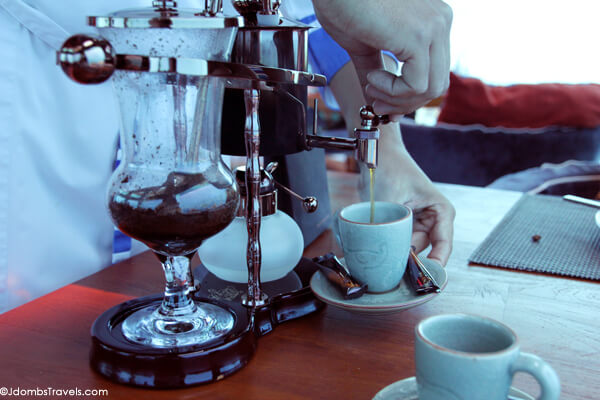
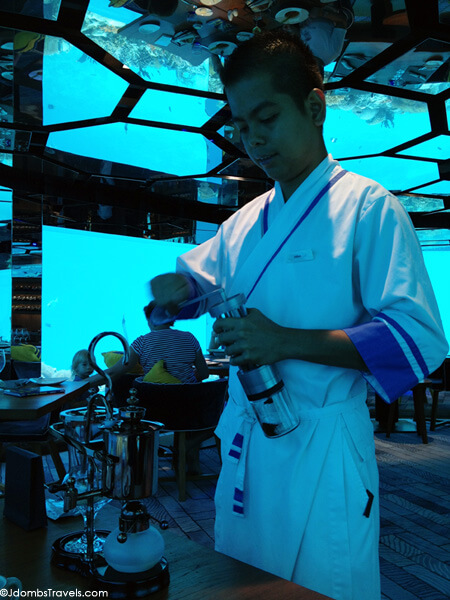 Black Ivory coffee is only available at Anantara luxury hotels and resorts in a few remote corners of the world – Thailand, the Maldives, and Abu Dhabi – and only 50 kilograms (110 pounds) were produced in 2012. We had it on our trip to the Maldives with Anantara Kihavah Villas as the perfect end to our underwater meal at Sea. Drinking it feels so exclusive! The coffee beans were hand ground at our table and the brewed in front of us using technology developed in Austria in 1840.
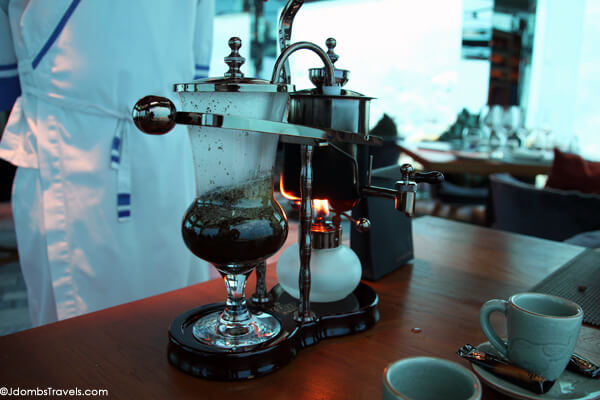 We were enchanted by the brewing process! The little Austrian machine has two chambers and is like a balance. The heated chamber is weighted and the water heats up to 93°C. It slowly filters into the glass chamber and the flame is snuffed out by the counterweight, the coffee brews, and then siphons back into the heated chamber. The whole brewing process took around 5 minutes and definitely attracted the attention of other diners.
It far surpassed our expectations and we enjoyed the earthy flavor of the brew. Interestingly, Black Ivory coffee is sweetened with chocolate instead of sugar and always served black.
So what will it cost you to sample a cup? Black Ivory coffee retails at $1100 per kilogram and a cup at one of Anantara’s resorts is $50.

Andi of My Beautiful Adventures says
I would like to try it, but damn that’s a lot of money!
Jennifer Dombrowski says
It’s kind of nuts, Andi! And we were told that the entire 2012 supply had sold out. It’s definitely something interesting to try at least once. The little pot made at least 2 cups each for both of us to share.
Ali says
I’m not a coffee drinker, but it’s definitely interesting. I’ve always read that coffee from civets is the most expensive coffee in the world. It’s the same concept, the civet eats and later craps out the coffee beans, and the price is insane. We got to try some in Indonesia, one of the primary places where it’s produced.
Jennifer Dombrowski says
How was it?
Black Ivory is quite new, just hitting the market about a month before our trip to the Maldives. I think the cat poo coffee was the most expensive until Black Ivory was introduced.
Who comes up with the idea to collect coffee beans from cat or elephant poo anyway?!
Andrea says
Now I thought the only poop coffee was from those civet cats (hope that’s my memory serving me right) – elephants too? And they are all pricey? Far out!
Jennifer Dombrowski says
I know. Who exactly decided to try coffee beans that any animal had eaten and excreted? The civet poo coffee is around $10 per cup, which in the scheme of the Black Ivory at $50 per cup, isn’t too bad! I haven’t tried the civet poo coffee, but I did really like the Black Ivory.
D.J. - The World of Deej says
This is something I would definitely do, just once. Great experience!
Jennifer Dombrowski says
Black Ivory really is an entire experience, not just a cup of coffee! Definitely give it a try if you get the chance, D.J.
Natalie says
With things like this it always makes me wonder, who discovered it in the first place and what were the circumstances that led them to pick through elephant dung! I would try it at least once.
Jennifer Dombrowski says
Me too. Me too, Natalie! It’s a burning question on everyone’s minds. I may just have to go to Thailand to find out!
Cole @ FourJandals.com says
Wonder if we will be able to find it in Thailand when we go in a few months! Not sure I want to try it but sort of a once-in-a-lifetime-experience I guess haha.
Jennifer Dombrowski says
Yes! You can even visit the elephant rescue foundation where it is harvested. It’s called the Anantara Golden Triangle.
Jealous you are going to Thailand! Can’t wait to follow along with your adventures there.
Blake says
Thanks Jennifer for the article and we are glad you enjoyed drinking Black Ivory Coffee. Your readers can experience a cup in Maldives but also in Thailand in Chiang Saen at the Anantara Golden Triangle. We produce the coffee next door at the Golden Triangle Asian Elephant Foundation. It will shortly be sold at the Grand Hyatt Erawan in Bangkok as well. You can even try it in Comfort, Texas at The Elephant Story (all sales go back to support elephant charities).
I worked with civets before creating Black Ivory Coffee. The challenge was SARS (civets spread SARS from animals to humans in China) and the fact that farmers were rubbing dung on the beans and trying to pass counterfeit coffee off as the real thing (according to Dr. Marcone of the U. of Guelph 50-70% of civet coffee is fake). Finally civets are now being forced into cages and force fed coffee.
Scientifically there is a taste difference because elephants are herbivores while civets are omnivores. Omnivores digest with more acidity to break down protein rich foods such as meat. Herbivores such as elephants use more fermentation to break down green leafy matter and fermentation helps to impart the fruit of the cherry into the bean.
We have created a great cup of coffee (100% Thai Arabica beans) that is produced at a charitable foundation (www.helpingelephants.org). Tourists can come and witness our production process and we have elephant vets who monitor the process. 8% of our sales go back to the the Golden Triangle Asian Elephant Foundation and we combine this unique production with the process that you so well describe.
Feel free to contact me by email as well as through our website.
Best Regards,
Blake
Jennifer Dombrowski says
Thanks for all the fantastic additional info, Blake! We’d love to come see the production process for ourselves. And we think it’s great that a portion of the profits go toward caring for the elephants.
Matthew Hirtes says
Great post, Jennifer. I thought the coffee was on the expensive side here.
Turtle says
Wow! I hadn’t heard of this before but it sounds fascinating. I wonder if you can really tell the difference between this coffee and other ‘good’ ones. And I certainly wonder whether you can tell that it’s worth $50.
Jennifer Dombrowski says
It definitely tastes different and I think the whole experience of the coffee being ground and then brewed in such an exclusive machine adds to it all.
Blake says
Hi Turtle:
To answer your $50 question is tough. While I know we have excellent coffee because we start with excellent beans and take care every step of the process it may not always matter with many people and here’s why. We hired an expert coffee roaster a number of years ago. He had worked for a company that sold cheap brick coffee that you find on supermarket shelves. Turns out customers starting complaining about their coffee en masse. It seems the culprit was that they were able to cut delivery time from farm to shelf by 6 weeks. The result: customers had grown accustomed to stale coffee and that was what they yearned. When they tried fresh coffee they thought it was off and compared to what they knew it was.
What I would like to say is that coffee has a lot of subjectivity. Yes it can be scored by professionals but the reality is that some people like coffee with acidity while others don’t, some like fruit while others prefer chocolate. Finally the brewing process affects the cup too. In short I would be skeptical of anyone who touts their own coffee as the best in the world. I say be critical, inquire about the process and if it is still interesting try it and see for yourself. Yes Black Ivory Coffee may be the most expensive cup in the world but I can assure you 1) you will have an experience found nowhere else 2) the taste will be very good (whether it is the best you ever had is up to you to decide) and 3) you will feel good knowing that your purchase helps support the Golden Triangle Asian Elephant Foundation in Chiang Saen Thailand.
Please feel free to write to me at my website at http://www.blackivorycoffee.com if you have any other questions.
Best Regards,
Blake
Jennifer Dombrowski says
Thanks for the insight, Blake! I am definitely interested in visiting the Golden Triangle to learn more about the process of making Black Ivory. It would be a great follow up to this post. 🙂
jasha says
hope there is a site that would tell me when was the black ivory discovered
Jennifer Dombrowski says
Hi Jasha! Black Ivory was sold for the first time in 2012 and is produced at the Anantara Golden Triangle in Thailand.
Erin says
I thought Kopi was the most expensive coffee in the world? up to $600 a pound, and up to $50 per cup. made from coffee beans eaten, partly digested and then excreted by the palm civet, a weasel-like animal. We had it in Bali, Indonesia. Either way both sound gross, but surprisingly aren’t haha. I too wonder who discovered poo coffee beans tasted better?!
Jennifer Dombrowski says
Kopi was before Black Ivory was invented. Kopi retails for $700 per kilogram and $10-$30 per cup. Black Ivory has only been around for about a year and produced in more limited quantities than Kopi.
Erin Bender (Travel With Bender) says
Now I have to drink more crap-uccino… Behind the times! 🙂
Jennifer Dombrowski says
Haha!! Too funny, Erin!
We’re off to Thailand later this year to get the inside scoop on how it’s made. I have a feeling we’ll be arm deep in the early makings of the crap-uccino. 😉
Blake Dinkin says
Hi Erin:
I am the person who discovered that elephants make more sense. I use to work with civets in Ethiopia and while there two things happened: farmers were rubbing dung on the beans and trying to pass it off as real Kopi Luwak and SARS epidemic started. Civets in China were responsible for the transmission of SARS and as a result 10,000 civets were exterminated. These were the two factors that made me switch and that was in 2003/2004. Today many producers of civet coffee, cage wild civets and feed them a diet primarily consisting of coffee. This is why animal welfare groups and Specialty Coffee Association has come out against Civet Coffee/Kopi Luwak.
Black Ivory Coffee is about starting with the best cherries, working with an animal that has a cleaner image and treating the animal humanely as well as providing financial support to improving their condition. It’s also about creating a unique experience for the guest and that’s why I sell exclusively at five star hotels.
Unfortunately now some people are trying to copy me and in order to ensure this method of production remains ethical I am trying to obtain intellectual property protection for the process. For this reason you can actually buy Black Ivory Coffee from directly until August 19. Here is the link: http://igg.me/at/BlackIvoryCoffee/x/3854315
Jennifer, please let me know when you will be planning a visit as it would be a pleasure to show you how Black Ivory Coffee is made at the Golden Triangle Asian Elephant Foundation (Anantara is an important donor but GTAEF is a separate Thai registered charity http://www.helpingelephants.org).
Best Regards,
Blake
Jennifer Dombrowski says
Hi Blake! It would be great to meet you and see the process. We’ll be at Anantara Golden Triangle November 18-22.
Erin Bender (Travel With Bender) says
That is so cool, thanks for writing back – so interesting!
Blake Dinkin says
Hi Jennifer
I was not planning on producing coffee at that time because the harvest does not take place at that time of year but if you can remind me at the beginning of October I will see if I can save some coffee for you. I will be at the sanctuary for a good chunk of October and then for two days potentially in November but I believe it will be around the 28 of November and not the week before.
Please keep me posted and I will try my best to meet you. It would be a pleasure on my part.
All the best,
Blake
Angela Turner says
More expensive doesn's always means best in flavor or digestability. If this method to make coffee was invented in Austria I wonder if Austria is still using it and if not then why not? I like that the money goes in part to care for the elephants.
Blake says
Hi Angela:
I agree that more expensive does not always translate to the best. In the case of Black Ivory Coffee it has taken me 10 years to develop the process because I care about creating a great taste. While taste is subjective I think the fact that many of the top hotel brands in the world are now carrying gives it some credence as well as the fact that my coffee was showcased this past April at Asia’s Best 50 Restaurants. Further the number 1 coffee roaster in the world (from South Korea) stated that my coffee cherries pre elephant is the best he has had in Thailand. That said, taste is very subjective and frankly the taste is much softer than regular coffee, its almost tea-like. Summary of taste:
Aroma: Floral and chocolate
Taste: chocolate, malt, cherry and hint of grass no burnt of bitter tastes
Finish: clean, caramel not bitterness.
Finally, its just the brewing machine that was invented in Austria not the coffee. The coffee was invented by me by working with elephants in Canada (zoo) and two elephants sanctuaries in Sumatra and in Chiang Saen (GTAEF).
Sand In My Suitcase says
Gulp! $50 for a cup! We like the idea of it being sweetened by chocolate instead of sugar…
Blake Dinkin says
Hi,
Just to clarify, it is US$50/serving not cup. One serving is 35 grams of beans which in turn serves roughly 5 espresso cups. As for sweetening the taste, all jokes aside, I promise you will find Black Ivory Coffee the easiest to drink coffee as it will not have any burnt flavour, bitterness (actually there is a touch of bitterness similar to the first bite of dark chocolate but this bitterness quickly leaves). It is also quite sweet with notes of chocolate, spice (I would suggest leather and tobacco notes) and malt.
We age our coffee and we will not sell our 2014 vintage until May as it takes around 5 months for the greenness to leave.
If you need more info feel free to contact me via my website or on Facebook.
Best Regards,
Blake
Blake Dinkin says
Hi Jasha.
You can learn more via the Black Ivory Coffee website: http://www.blackivorycoffee.com or the Black Ivory Coffee Facebook page.
Jennifer is right in that sales began late 2012. However, I discovered the process in 2004 and it has taken me close to 10 years to perfect the taste. If one were to just have an elephant eat coffee the resulting cup would be undrinkable. Trust me on this as I have tried it!
Best Regards,
Blake
Carolyn Stanley says
For the longest time, it was Kopi Luwak which reigned as the most expensive coffee in the world. It is because of the process and rarity of Luwak that made the coffee pricey. Now, it’s the elephant’s turn to seat at the throne. Who would have thought that this gentle giants could create something luxurious. Hopefully, I could try this “Black Ivory Coffee” when I get to travel in the countries where it’s sold. From what I’ve been reading, it tastes good and my $50 a cup would be worth it. Oh well, I am looking forward to that day.
Blake says
Hi Carolyn:
I appreciate your comment. If you like to try it and are not able to travel to the Maldives or other Asian countries that carry my coffee, I provided a link when I replied to Jasha just above where you can order a pack (35 grams which in turn serves 5 espresso sized cups).
Feel free to contact me if you have any questions through my website.
Best Wishes,
Blake
Chantelle says
Hi Blake, I’m writing a persuasive essay on your method of producing coffee for culinary school. I’m looking for some information that you’re willing to share with me or insight that the official site doesn’t have.
Thanks in advance, Chantelle
blake says
Hi Chantelle:
Contact me via the email on my website. Let me know what specific questions you have and I will try to help.
Blake